People - ZAB
The Zuid-Afrikaansche Boervolk
About Us?
Before we can determine WHO the Boervolk are, we must first look at the international definition of a people ("volk").
.
What Defines a People?
International law and the practice of the United Nations point to several criteria by which a nation ("volk") can be recognized as such. The key elements include:
- Territorial definition: A people owns or claims a historical home, whether in a state or non-self-governing territory.
- Shared identity: A common language, culture, history, faith, and ethnicity forms the backbone of a people's self-esteem.
- Self-Determination: The Right and Aspiration to Autonomously Determine Political, Social and Cultural Development.
- Self-Determination: The Right and Aspiration to Autonomously Determine Political, Social and Cultural Development.
- "The people" vs. "A people": A state's total population, the people, is different from a people with a separate (unique) identity.
South Africa has more than one white Afrikaans-speaking group, but there are fundamental ethnic, cultural and historical differences between the two main groups — the Boer and the Afrikaner.
The Boervolk and the Afrikaner: Origins and Development
The Boer and Afrikaner: Two different groups
The debate about identity in South Africa is anything but new, but is becoming more and more central today as groups rethink their right to self-determination and cultural recognition. The terms "Boer" and "Afrikaner" are not synonyms. The Boer is descended from the Migratory Boers (Trekboere) and Border Boers (Grensboere) who deliberately moved away from the Cape Colony in the 1600s–1800s due to colonial oppression. These people formed an anti-colonial, freedom-oriented identity, and later established 21 independent Boer Republics.
The Afrikaner, on the other hand, is primarily of Cape Dutch descent — a group that was pro-colonial, loyal to British or VOC authority, and later formed a political identity around Afrikaner nationalism. This group often opposed the Boer's freedom struggle.
Historical Roots
Boervolk refers to the descendants of frontier farmers (Trek- and later Frontierbore) who moved away from the Cape Colony from the late 1600s. Their semi-nomadic existence and conflict with the autocratic VOC created a culture of self-reliance that would eventually lead to the Great Trek and independent Boer Republics.
Afrikaner as a term first loosely originated in 1707, but was not officially politicised until 1875 when Cape Dutch intellectuals began to promote Afrikaans as a language. This identity revolves around a broader group of white Afrikaans speakers, mostly urban and more loyal to British or Cape colonial structures.
Colonial Fault Lines
The Cape elite – later Afrikaner politicians – regularly opposed the Boer's republican aspirations. Where the Cape Afrikaner remained subordinate to colonial authorities, the Boer followed an anti-colonial and republican course.
The Great Trek and Self-Determination
The Great Trek (1833–1846) is more than a migration; it confirmed the Boer people's aversion to imperialism and their right to decide on their own affairs. The Great Trek arose as a result of the British Government's unlawful and illegal rule over the Boer Republics of Swellendam and Graaf-Reinet since the late 1700s on the Eastern Cape. Farmers in Stellenbosch and large parts of the Cape also joined the resistance of the Boers of the Eastern Cape. In 1799 the Eastern Cape Boers' resistance to the British government increased and it reached a peak in 1815 at Slagtersnek where the Boer people were born and sought their freedom.
After the Great Trek, Boers founded, among others, the Republic of the Orange Free State and the South African Republic and defended their independence in two genocides by the British against the Boer people, incorrectly named the Anglo-Boer Wars as the Boer only had to protect their survival defensively.
Early Clashes
The Boer's first freedom conflict was not against the British, but against the Cape Dutch—the forerunners of the Afrikaner. This conflict later continued in opposition to British imperialism and the loyalists in the Cape. During the Anglo-Boer War, more than 50,000 Afrikaners fought on the British side against the Boer.
Political Assimilation through Afrikaner Nationalism and Identity Crisis
After the devastating genocide (Anglo-Boer War) and suppression in concentration camps, the Boer was plunged into poverty and slowed down. Afrikaner politics, especially through the National Party and Broederbond, gradually assimilated the Boer into an "Afrikaner nation" – a process reinforced by language politics, urban economic pressure and propagandistic historiography.
This eclipses the Farmer's unique identity; their republican spirit is subordinated to a Cape-centric elite. Examples include:
- The use of Boer symbolism (e.g. the Vow of 16 December 1838) for Afrikaner nationalist mobilisation in 1938.
- Legislative amendments and labour legislation linking the Boer economy to Afrikaner's interest.
- The rewriting of history works in which Boer is consistently replaced with Afrikaner.
Cultural and Language Differences
Although both groups speak Afrikaans, dialectical differences exist (Northern/Central Afrikaans vs. Cape Afrikaans). The Boer retains conservative, rural traditions that deviate from the more cosmopolitan Cape Afrikaner culture. As in other world examples (e.g., Scott Scott). Québécois vs. Acadians; Croats vs. Serbs) shared language does not equate to identical ethnicity.
The true Boer’s culture is determined by his faith in the Almighty Heavenly Father, for his entire existence is grounded and based on Father’s Word. He examines the Scripture himself and allows it to shape his life, decisions, and community. The Afrikaner, on the other hand, is often a habitual churchgoer who clings to church traditions and customs rather than personally investigating and obeying Father’s Word by living It. Thus, the Afrikaner’s culture is largely shaped by human usage and habit, while the Boer’s culture is formed by living the living Word of the Almighty Heavenly Father Himself. This difference is the core of the Boervolk’s unique identity and volkereg.
The Struggle for Self-Determination
During the 1900s, there were several attempts at rebellion and restoration of the Boer Republics—including the 1914 rebellion and the 1922 Rand Revolt. These efforts were repeatedly suppressed, and the Boer's political aspirations were replaced with Afrikaner nationalist agendas.
Why Identity Matters
To label the Boer as Afrikaner is to sacrifice their unique heritage and nationality to a group that has historically oppressed them. This is also why many Boers cannot consider themselves Afrikaners. They refuse to function as a political minority under a larger liberal, Cape-oriented Afrikaner identity.
Today's Meaning
The Boer people continue to strive for the restoration of their identity, their republics and their right to self-determination. To achieve this, there must be recognition that the Boer is not a subgroup of the Afrikaner — but a people in itself, with its own history, language variant, religious principles, culture and freedom legacy.
Contemporary Judgments and Recognition
Self-determination remains a valid international norm. The Boer people refer to international precedents and their own history of 21 recognised Boer Republics to substantiate a renewed demand for cultural and political autonomy. As well as the Treaty of Vereniging (especially clause 7) signed on 13 May 1902 condemning the genocide by the British against the Boer people. The Boer people have also been internationally recognised as a sovereign people on 2 occasions in history. During the Sandrivier Convention and the Bloemfontein Convention.
“The Boer can only be free if he is recognised as a Boer, not as a lesser part of a larger Afrikaner label.” – Henry Pinkham
Summary Conclusion
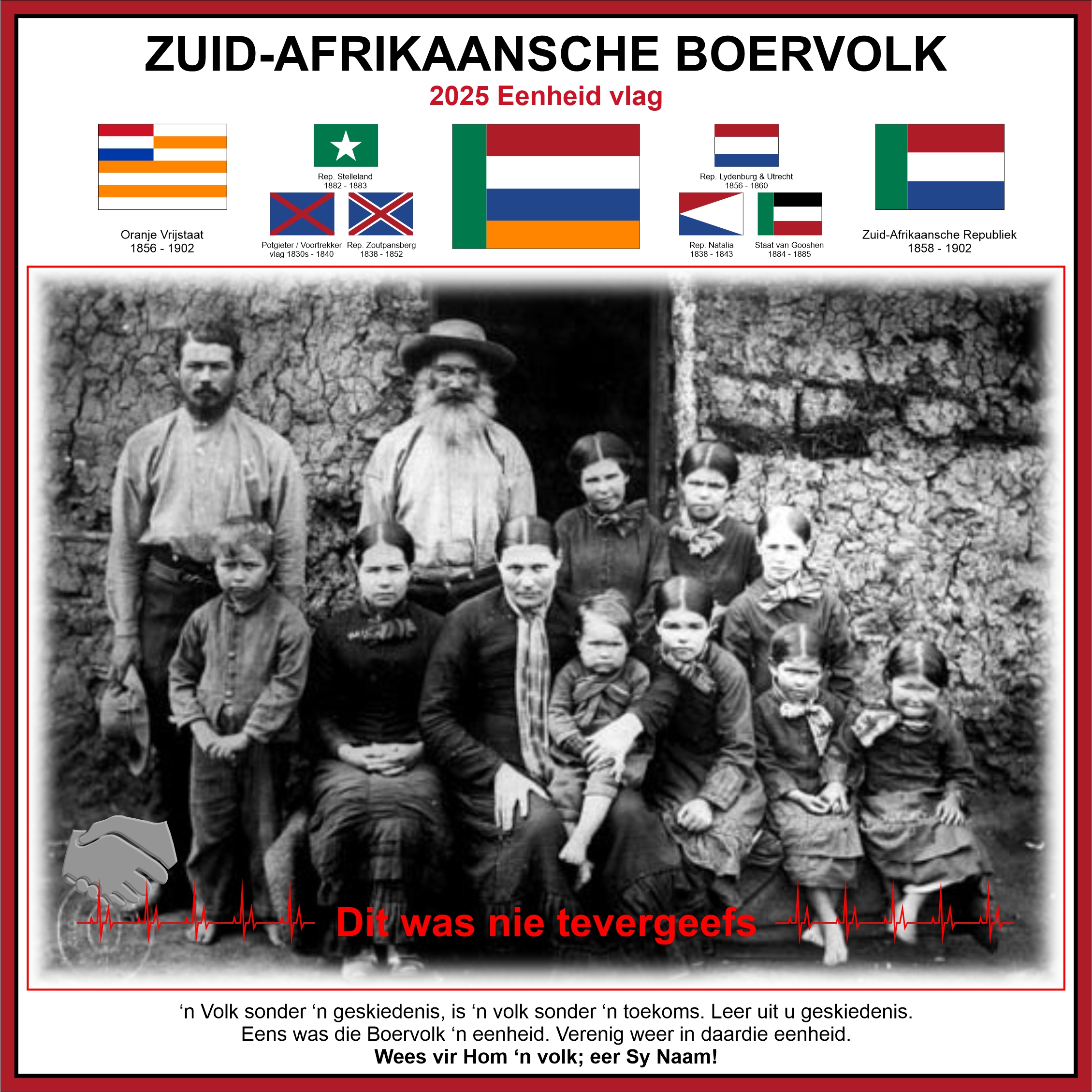
The history of South Africa is intertwined with efforts to unite diverse communities under one flag. However, this article shows that the Boer people, judged against international folk standards, have a distinct origin, culture, language variation, history and striving for self-determination. To classify the Boer people's identity as merely a subcategory of the Afrikaner negates their legal and moral claim to self-definition.
Acknowledging this difference is not divisive-seeding; it gives realistic recognition to cultural diversity and historical realities. The way forward requires reverence for history, respect for diversity, a peculiar space in which the Boervolk can shape their future in accordance with their unique legacy and an acknowledgement of the Boervolk's right to exist, rooted on her trust in the Almighty Heavenly Father and His full Word.
Reed The Boer Declaration of the Zuid-Afrikaansche Boervolk. If you can identify with it, the Administration will be happy to assist you in taking your rightful place in the People's House.
Further Information:
ZABR_Openb_Ken_007: Boervolk Identiteit, Onafhanklikheid en Nie-verbondenheid
UNPFII Att. B: International Submission on Afrikaner and Boervolk Status
UNPFII Att. H: Boervolk Identity Clarification
Boer of “Afrikaner” (of dalk Brit)
Who are the Boers - The Truth at last
TV interview: Agenda: 1992 - Robert v Tonder en ander


The ZABR is a cultural administrative body and its initiatives are focused on the preservation of Boer heritage, in accordance with South African laws.